Battle of Nashville & Beyond

  • Home
    • Resources
      • Franklin
      • Shiloh
    • About the Author
  • Tour Routes
    • Tour Route – 2 hours
    • Tour Route – 3 Hour
    • Tour Route – 6+ hours
  • Gunships vs Cavalry
    • Naval Battle Timeline
    • Brown Water Navy
    • The Gunboats of Nashville
      • Nashville Gunboats Photos
      • U.S.S. Cairo Virtual Tour
  • Kelley’s Point
    • Kelley’s Point Map
    • Kelley’s Point Naval Battle
    • 1936 Aerial Photo
    • Inset Zoom of Kelley’s Point
    • People of Interest
      • Le Roy Fitch
      • Mark Robertson Cockrill
      • Col. David C. Kelley
      • Richard W. Johnson
        • Battlefield Simulator
      • Hood’s Retreat
  • Blog
  • Hood’s Retreat
  • Virtual Battlefields
  • Athens-South Virtual Tours

May 9, 2016 By Bob Henderson 3 Comments

Nashville National Cemetery

Nashville National Civil War Cemetery in 3D 


1420 Gallatin Pike S, Nashville, TN 37115 • Monday-Friday 8:00 -16:30


General Thomas chose a site on the battlefield, marked by a hill, to bury the more than 2,000 Union dead. He said:

“No one could come to Nashville from the north and not be reminded of the sacrifices that had been made for the preservation of the Union.”usct-image

The War Department renamed the 64-acre Union burial ground Nashville National Cemetery in 1866. Remains were moved here from city hospital grounds, battlegrounds, sites along the Cumberland River, and forts, blockhouses, and engagement sites along the three railroads that converged in Nashville. Because two years had elapsed between the original burials and the reinterments, many dead could not be identified. However, the Roll of Honor No. XXII (1869), published by the War Department, lists soldiers likely buried here in graves marked “unknown.”

In 1870 the army built a 32-foot-high monumental Neoclassical archway facing Gallatin Pike as the cemetery entrance. It is the oldest of five such arches erected in southern national cemeteries. By 1874, an estimated 16,538 individuals were buried here, with approximately one-quarter unknown.

Monuments at Nashville National Cemetery

Two monuments honor Civil War soldiers here. In 1913, the Minnesota Monument Commission selected St. Paul sculptor John K. Daniels to create monuments for five national cemeteries. His design reflected Minnesotans’ perception of the noble character of their fallen soldiers, and the cause for which they fought. This monument was dedicated May 18, 1921. 

[Minnesota lost more men (87) at the Battle of Nashville than in any other Civil War battle.]

The Tennessee U.S. Colored Troops (USCT) Monument, a 9-foot-tall bronze figure of a black soldier, honors the 1,910 USCT buried here. Many were members of the 1st and 2nd Colored Brigades who fought and died in the Battle of Nashville. Sculpted by Roy Butler, the monument was dedicated in 2006.*

[A soldier in the 18th Alabama fumed, “To our disgust, they were all Negroes.” Five color bearers of the 13th USCT — carrying a flag emblazed with its origin:  “Presented by the Colored Ladies of Murfreesboro” — were shot down before their banner was captured. The regiment lost 40 percent of its men, the highest casualty rate of the battle. No side lost more than the 13th at Nashville.]  – cwpt.org

*source: signage from below (front entrance to the cemetery)


inc-img


3D Imagery of the Nashville National Cemetery Civil War Monuments

Note: get the full screen experience of this virtual tour by clicking the icon in the lower left of the video frame. A zoom option is available also for reading the historical signage. Some markers are embedded in the floating icons.

This content requires HTML5/CSS3, WebGL, or Adobe Flash Player Version 9 or higher.

#nationalcemetery #nashville #civilwar #virtualtour #usct #minnesota


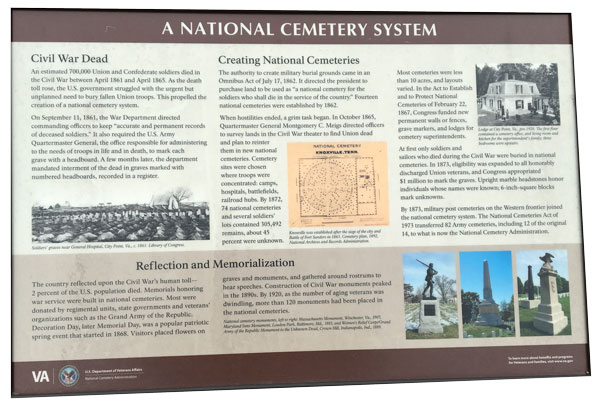
 Civil War Dead 

An estimated 700,000 Union and Confederate soldiers died in the Civil War between April 1861 and April 1865. As the death toll rose, the U.S. government struggled with the urgent but unplanned need to bury fallen Union troops. This propelled the creation of a national cemetery system. On September 11, 1861, the War Department directed commanding officers to keep “accurate and permanent records of deceased soldiers.” It also required the U.S. Army Quartermaster General, the office responsible for administering to the needs of troops in life and in death, to mark each grave with a headboard. A few months later, the department mandated interment of the dead in graves marked with numbered headboards, recorded in a register.

Creating National Cemeteries

The authority to create military burial grounds came in an Omnibus Act of July 17, 1862. It directed the president to purchase land to be used as “a national cemetery for the soldiers who shall die in the service of the country.” Fourteen national cemeteries were established by 1862. When hostilities ended, a grim task began. In October 1865, Quartermaster General Montgomery C. Meigs directed officers to survey lands in the Civil War theater to find Union dead and plan to reinter them in new national cemeteries. Cemetery sites were chosen where troops were concentrated: camps, hospitals, battlefields, railroad hubs. By 1872, 74 national cemeteries and several soldiers’ lots contained 305,492 remains, about 45 percent were unknown. 

Most cemeteries were less than 10 acres, and layouts varied. In the Act to Establish and to Protect National Cemeteries of February 22, 1867, Congress funded new permanent walls or fences, grave markers, and lodges for cemetery superintendents. 

At first only soldiers and sailors who died during the Civil War were buried in national cemeteries. In 1873, eligibility was expanded to all honorably discharged Union veterans, and Congress appropriated $1 million to mark the graves. Upright marble headstones honor individuals whose names were known; 6-inch-square blocks mark unknowns. By 1873, military post cemeteries on the Western frontier joined the national cemetery system. The National Cemeteries Act of 1973 transferred 82 Army cemeteries, including 12 of the original 14, to what is now the National Cemetery Administration. 

Reflection and Memorialization 

The country reflected upon the Civil War’s human toll – 2 percent of the U.S. population died. Memorials honoring war service were built in national cemeteries. Most were donated by regimental units, state governments and veterans’ organizations such as the Grand Army of the Republic. Decoration Day, later Memorial Day, was a popular patriotic spring event that started in 1868. Visitors placed flowers on graves and monuments, and gathered around rostrums to hear speeches. Construction of Civil War monuments peaked in the 1890s. By 1920, as the number of aging veterans was dwindling, more than 120 monuments had been placed in the national cemeteries.**

**source: signage from below (north side of the cemetery)
 

va-sign-img

Suggested readings:

The Decisive Battle of Nashville

Shrouds of Glory – From Atlanta to Nashville: The Last Great Campaign of the Civil War

Nashville: The Western Confederacy’s Final Gamble

Bob Henderson | Athens-South
Filed Under: Blog, Cemetery, Nashville, The American Civil War, USCT, Virtual Tour

January 29, 2016 By Bob Henderson Leave a Comment

Old City Cemetery

The Nashville Old City Cemetery 

A Virtual Tour of the Old City Cemetery in Nashville including the grave of “Old Glory” William Driver.

“In order to save the flag from further threats, Driver (aided by loyal women neighbors) had it sewn into a coverlet and hidden until late February 1862, when Nashville fell to Union forces. When the Union Army (led by the 6th Ohio Infantry) entered the city, Driver went to Tennessee State Capitol after seeing the American flag and the 6th Ohio’s regimental colors raised on the Capitol flagstaff.” …read more

This content requires HTML5/CSS3, WebGL, or Adobe Flash Player Version 9 or higher.

Readings:

#oldcitycemetery


Filed Under: Cemetery, Nashville, Virtual Tour

December 10, 2015 By Bob Henderson

Gunboat Vessels of Nashville

Gunboats that fought in The Battle of Nashville: 

These are some of the United States “Brown Water Navy” vessels that fought on the Cumberland River in December 1864, under the command of Lieutenant Commander Le Roy Fitch. There were six separate engagements from December 2 to the 15th of that year.

City Class U.S.S. Carondelet Ironclad Gunboat

Carondelet Photo

Seven city class gunboats were built by James B. Eads at a cost of $89,000 each. With 13 guns, from 30-pdr. Parrotts, up to 100-pdr., they were powerfully armed. Their 2.5 inch plating, plus wood backing, was not impenetrable, however. The sister ship Cairo was sunk by torpedo in December 1862. She was raised in 1964 and is on display at the Vicksburg National Military Park. The Carondelet was also involved in many other river battles including Forts Donelson and Henry, Island #10, and the siege of Vicksburg.

U.S.S. Neosho Ironclad Gunboat

USS Neosho Photo

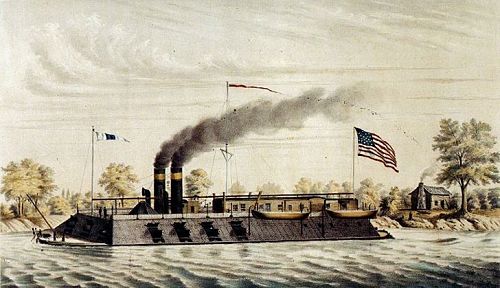
December 6, 1864 aboard the U.S.S. Neosho, Quartermaster John Ditzenback, and Pilot John H. Ferrell received the Medal of Honor for retrieving the United States flag which had been shot away.  Under heavy enemy fire, they left the safety of the armored pilot-house, and tied it to the main signal staff. This drawing was featured in Harpers Weekly.

USS Neosho Photo

The river monitor Neosho was hit more than one hundred times in one of the, many engagements at this site, severely damaging her stern house and chimney.  It narrowly escaped destruction when an unexploded shell lodged near her powder magazine. 78 years latter, her namesake would not be so lucky.  She was sunk by the Japanese in the Battle of Coral Sea, May 11, 1942.  

U.S.S. Silverlake Tinclad Gunboat

USS Silverlake Photo

This tinclad sternwheeler gunboat fought here.  She had a crew complement of 150 men. The boat carried eight 24 -pdr. brass guns. She also participated in action at Florence, Alabama, Palmyra, Tennessee, and the pursuit of Morgan’s raiders on the Ohio River

U.S.S. Fairplay Tinclad Gunboat

USS Fairplay Photo

This tinclad was a Confederate transport captured by the Union Navy at Milliken’s Bend, Louisanna on 18 August 1862.  It was the initial command vessel in the battle of Bell’s Bend for the Navy flotilla.  After the second engagement with the Confederates the tinclad was severely damaged. Commanding Officer Lieutenant Commander Le Roy Fitch then decided to transfer his flag to the more heavily armored U.S.S. Neosho.

The U.S.S. Moose and U.S.S. Brilliant tin clad was also part of this flotilla, but no know photo exists of her. 

Suggested readings:

#gunboats #nashville #civilwar #usn

Filed Under: Nashville, Ships, United States Navy

October 30, 2015 By Bob Henderson Leave a Comment

Mass Grave Mystery

Ed Miles Interview about a mass grave in his old back yard:


Ed Miles interview in 1997 about a mass grave in West Nashville: He grew up on this property and describes a burial site they discovered when his father sold off some of their adjacent land, and it was being developed. A bulldozer operator unearthed a human scull while cutting the road, which is now called Alfred Drive. Evidence strongly suggest they are Civil War soldiers.

I’m sad to hear that Ed has passed away. I’m glad I filmed this, because nobody would believe it. Many still don’t. His impressive obituary adds even more credibility to the story. This site was categorized as a Native American burial site. Evidence here, suggests otherwise.

UPDATE: 2019 

A Green Beret friend of mine suggested the straw and hay was used for insolation in their jackets.


#battleofnashville #civilwar #battlefielddetective

Top of the Hill
End of the Street

Filed Under: Cavalry, Nashville, The American Civil War

December 13, 2014 By Bob Henderson Leave a Comment

Photos Past & Present

TN ImagePhoto Imagery of Past & Present Vantage Points


“Battle lines were formed south of Nashville awaiting a Confederate advance. This line was south of Ft. Casino, which is the present day water reservoir on 8th Ave. Reservoir Park is at this location currently. Historic photo from Civil War glass negative collection” (Library of Congress). 2014 color photo and photo merge illustration by Larry McCormack (Photo: Larry McCormack, / The Tennessean) …see more


Filed Under: Nashville

  • « Previous Page
  • 1
  • …
  • 4
  • 5
  • 6
  • 7
  • Next Page »
  • Facebook

Battlefield Trust

CWPT Link

Tennessee State Museum

DSC02614_5_6_7_8_opt

Fort Negley

Negely

USCT Charge on Peach Orchard Hill

USCT Painting

Travelers Rest

Travelers Rest

Belle Meade Plantation

Belle Meade Plantation

Battle of Franklin

Franklin

Nashville Naval Battle

Kelley’s Point Video

Nashville MIA’s

Copyright © 2026 · Bob Henderson. All rights reserved.