Battle of Nashville & Beyond

  • Home
    • Resources
      • Franklin
      • Shiloh
    • About the Author
  • Tour Routes
    • Tour Route – 2 hours
    • Tour Route – 3 Hour
    • Tour Route – 6+ hours
  • Gunships vs Cavalry
    • Naval Battle Timeline
    • Brown Water Navy
    • The Gunboats of Nashville
      • Nashville Gunboats Photos
      • U.S.S. Cairo Virtual Tour
  • Kelley’s Point
    • Kelley’s Point Map
    • Kelley’s Point Naval Battle
    • 1936 Aerial Photo
    • Inset Zoom of Kelley’s Point
    • People of Interest
      • Le Roy Fitch
      • Mark Robertson Cockrill
      • Col. David C. Kelley
      • Richard W. Johnson
        • Battlefield Simulator
      • Hood’s Retreat
  • Blog
  • Hood’s Retreat
  • Virtual Battlefields
  • Athens-South Virtual Tours

December 12, 2017 By Bob Henderson 2 Comments

Kings Mountain South Carolina

Mountain-men won the Revolutionary War: 

The American War for Independence nearly failed in 1780. Appalachian “Overmountain Men” turned the tide at Kings Mountain. My G5, William Maxwell, was part of it.

I was surprised to learn that the British Commanding Officer Colonel Patrick Ferguson, was the only man from Briton on the field. Additionally, Ferguson had General George Washington literally in his gun site at one point in the war. He refused to take the shot when the general turned his back while lining up his site. 

Killed in the Kings Mountain battle, Colonel Fergusons death denied the British the use of a breach loading musket he was developing, that could have changed the course of the war.

This is a top rated National Park, and a must-see for any history buff. A wonderful interpretive film from The History Channel. Interpretive signage is first rate, the walking paths are cushioned asphalt. Beautiful scenery. In the winter the vista from the top is wonderful.

Cowpens National Battlefield Park is very well done too. I wish there were more sites like these. The Cowan’s Ford Battlefield doesn’t even have a pull-off on the highway.

Kins Mountain National Battlefield is ocated at 2625 Park Rd, Blacksburg, SC 29702

360º of Kings Mountain Virtual Reality Tour

This content requires HTML5/CSS3, WebGL, or Adobe Flash Player Version 9 or higher.
Wikipedia

Militiaman William Maxwell

born: 1756, Pennsylvania

died: 07 December 1838, Smith County, Tennessee

married: Elizabeth Parke 11 June 1785, Mecklenburg County, North Carolina

Pension application October 2, 1832

“…declarant again volunteered his services, though he cannot recollect the date of the service, from the County of Mecklenburg and joined the Company commanded by Captain James Houston and rendezvoused near Charlotte and crossed the Catawba and marched towards Kings Mountain. Declarant was one of the advance guard under the command of Captain Thomas Shelby – and joined the corps under the command of Col Campbell [William Campbell] and under him Cols Shelby [Isaac Shelby] and Sevier [John Sevier]. Declarant was in the battle that was fought at that place [Battle of Kings Mountain, October 7, 1780] , and he recollects that his Captain Houston received a wound in the knee, which disabled him. After the battle of Kings Mountain declarant returned with his company home, and was discharged. Shortly after his return home, he again volunteered his services under Captain Richard Simmons…”

Veteran was pensioned at the rate of $88.33 per annum commencing March 4th, 1831, for service as a private for 10 months in the cavalry and 14 months in the infantry, all in the North Carolina militia.

From: The Patriots at Kings Mountain by Bobby Gilmer Moss

“William Maxwell moved to Mecklenburg County, North Carolina, as a youth. While residing there he enlisted under Capt. Charles Polk, Lt.-Col. Polk, and Col. Alexander Martin and marched to Cross Creek against the Scotish Tories. Thereafter, he volunteered under Capt. Shelby and was in the battles at Ramsour’s Mill and Raft Swamp. He was in Gates’s Defeat. He then enlisted under Capt. James Houston and was in the battle at Kings Mountain. Maxwell enlisted under Capt. William Alexander, marched to South Carolina, joined Col. Hampton, and was in the skirmish at Quarter House and the battle at Blackstock’s Plantation. He was under Capt. James Maxwell* in the skirmishes at Cowan’s Ford and Torrence’s Tavern. Thereafter, he was under Capt. Richard Simmons, Maj. Graham, Col. Robert Smith, and Gen. Rutherford on the Wilmington Expedition and was in the engagement at the Brick House. He executed a pension application 2 October 1832 while residing in Rutherford County, Tennessee, and aged seventy-six years. His widow executed a pension application 5 September 1839 while residing in Smith County, Tennessee. Their children were: Charlotte (26 April 1789), James (27 February 1791), John (14 February 1793), Lydia (3 February 1795), William (3 January 1797), Elizabeth (18 December 1798), Robert (6 May 1805), Jesse (18 April 1807), and Nancy (5 August 1810). His widow died 8 February 1840. FPA R7046; PI.”

Willam Maxwell’s grandson James Jarvis Maxwell served with the 4th Tennessee Mounted Infantry (U.S.) in the American Civil War. He said his choice on which side to serve, was based on his grandfathers sacrifice for the United States in the Revolutionary War. His younger brother William** fought for the South. Family legend has it, that if it had not been for the intervention of their mother, one of them would have killed the other on at least one occasion.

*Captain James Maxwell is father of William Maxwell

**William Maxwell possibly served with the 13th Tennessee Cavalry CSA.

William Maxwell is my 5th great-grandfather, James Jarvis Maxwell my 3rd: Bob Henderson
Filed Under: Revolutionary War, South Carolina

November 6, 2017 By Bob Henderson 3 Comments

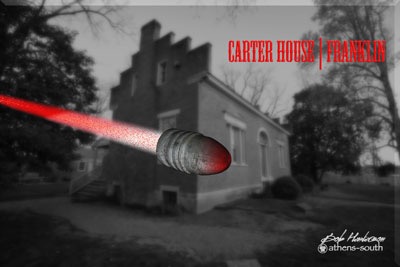
Carter House Virtual Tour

Battle of Franklin Ground Zero

carter-house-image
1140 Columbia Ave, Franklin, TN 37064
 

Revised: 22 November 2017

Take a virtual tour of the historic American Civil War sites in Franklin, Tennessee. Shot on location at The Carter House, Cotton Gin, Fort Granger, Winstead Hill and Carnton Plantation. 

#virtualtour #franklin #carterhouse

Wikipedia

© Bob Henderson | Athens-South

Filed Under: Franklin, Hood, The American Civil War, Virtual Tour

November 6, 2017 By Bob Henderson Leave a Comment

Carter Gin Site and Park

The new Battle of Franklin interpretive park

1221-1235 Columbia Ave, Franklin, TN 37064
Battle of Franklin: November 30, 1864

Complete with three replica 3-inch Ordinance rifles and 6 new interpretive signs, Franklin increases the amount of reclaimed battlefield. More than 20 acres now make up Carter Hill Battlefield Park, which continues to expand. The signage also includes extensive details on the Williamson County African American experience during the American Civil War.

Parking is not available on the site, but Carter’s Court and the Carter House are right next door and across the street.

#battleoffranklin

Filed Under: Franklin, Hood, Parks, Tennessee

October 16, 2017 By Bob Henderson Leave a Comment

Jefferson Davis

Jefferson Davis Monument: 

258 Pembroke-Fairview Rd, Fairview, KY 42221

Jefferson Davis Kentucky State Historic Site

“Jefferson Davis State Historic Site is a memorial to the Kentuckian born on this site on June 3, 1808.  The monument is a 351-foot obelisk constructed on a foundation of solid Kentucky limestone. An elevator takes visitors to the top for a bird’s eye view of the countryside. A museum on the grounds provides visitors with a bit of insight into this leader’s fascinating life.”

“Jefferson Davis (born Jefferson Finis Davis; June 3, 1808 – December 6, 1889) was an American politician who served as the President of the Confederate States from 1861 to 1865. He was a member of the Democratic Party who represented Mississippi in the United States Senate and the House of Representatives prior to becoming president of the Confederacy. He was the 23rd United States Secretary of War, serving under U.S. President Franklin Pierce from 1853 to 1857.

Davis was born in Fairview, Kentucky, to a moderately prosperous farmer, and grew up on his older brother Joseph’s large cotton plantations in Mississippi and Louisiana. Joseph Davis also secured his appointment to the United States Military Academy. After graduating, Jefferson Davis served six years as a lieutenant in the United States Army. He fought in the Mexican–American War (1846–1848), as the colonel of a volunteer regiment. Before the American Civil War, he operated a large cotton plantation in Mississippi and owned as many as 74 slaves. Although he argued against secession in 1858, he believed states had an unquestionable right to leave the Union.

Davis’s first wife, Sarah Knox Taylor, died of malaria after three months of marriage, and he also struggled with recurring bouts of the disease. He was unhealthy for much of his life. At the age of 36, Davis married again, to 18-year-old Varina Howell, a native of Natchez, Mississippi, who had been educated in Philadelphia and had some family ties in the North. They had six children. Only two survived him, and only one married and had children.

Many historians attribute the Confederacy’s weaknesses to the poor leadership of Davis. His preoccupation with detail, reluctance to delegate responsibility, lack of popular appeal, feuds with powerful state governors and generals, favoritism toward old friends, inability to get along with people who disagreed with him, neglect of civil matters in favor of military ones, and resistance to public opinion all worked against him. Historians agree he was a much less effective war leader than his Union counterpart Abraham Lincoln. After Davis was captured in 1865, he was accused of treason and imprisoned at Fort Monroe. He was never tried and was released after two years. While not disgraced, Davis had been displaced in ex-Confederate affection after the war by his leading general, Robert E. Lee. Davis wrote a memoir entitled The Rise and Fall of the Confederate Government, which he completed in 1881. By the late 1880s, he began to encourage reconciliation, telling Southerners to be loyal to the Union. Ex-Confederates came to appreciate his role in the war, seeing him as a Southern patriot, and he became a hero of the Lost Cause in the post-Reconstruction South.” – Wikipedia

360º Panorama of the Jefferson Davis Monument:

#jeffersondavis

Filed Under: Kentucky, Virtual Tour

October 15, 2017 By Bob Henderson Leave a Comment

Lindsley Hall

University of Nashville, Western Military Institute and Montgomery Bell Academy:

Hospital No. 2, housing 300 beds during the Civil War Federal Occupation of Nashville

“In 1853, a new building was constructed at 724 Second Avenue in Nashville, and in 1854, the literary college re-opened. In 1855, Lindsley’s son and successor John Berrien Lindsley merged the Western Military Institute and the University of Nashville. It moved its entire operation from Georgetown, Kentucky, where it had operated since its founding in 1847, to Nashville. Bushrod Johnson was a professor at the Western Military Institute from 1851 to 1855. He served as its headmaster when it moved to Nashville in the merger, and continued in that capacity until the outbreak of the American Civil War in 1861. He served the Confederate States Army during the war as a general  It was during this period that Sam Davis attended the Western Military Institute; he was later called the “boy hero of the Confederacy”, and hanged by Union forces as a spy in 1863. The Western Military Institute did not offer instruction from 1862 to 1865. During 1862, the campus building served as a Union hospital for Federal officers.

Industrialist Montgomery Bell left the University of Nashville $20,000 in his will in 1867, and Lindsley used the proceeds to open up the Montgomery Bell Academy (MBA) that year as a new preparatory school in Nashville. The new school took over the operations of the then defunct Western Military Institute and the University of Nashville preparatory school.” 

WMI Button – Courtesy of Marty Gates

Notable alumni: 

  • Hampton J. Cheney, Confederate veteran and Tennessee State Senator.
  • Thomas J. Latham, bankruptcy judge and businessman in Memphis, Tennessee.
  • John W. Morton, Tennessee Secretary of State from 1901 to 1909.
  • Joseph Toole – first and fourth Governor of Montana
  • José Andrés Coronado Alvarado (1895–1975), Costa Rican diplomat who served as head of Latin American relations while at the university.
  • William Barksdale, U. S. congressman and Civil War General, killed at Gettysburg (July 3, 1863).
  • John Bell (1797–1869), Tennessee senator and presidential candidate (graduate of Cumberland College)
  • Rufus Columbus Burleson, second president of Baylor University, Baptist preacher.
  • Sam Davis, boy hero of the Confederacy.
  • George Maney, Confederate general and U.S. diplomat to several South American countries.
  • Van. H. Manning (1839–1892), U.S. representative from Mississippi and Confederate States Army officer during the American Civil War.
  • Albert A. Murphree, (1870–1927), president of Florida State College for Women (1897–1909) and the University of Florida (1909–1927).
  • Gideon Johnson Pillow, (1806–78), U.S. and Confederate States Army general and lawyer.
  • Peter Pitchlynn, 1806–1881), chief of the Choctaw Nation of Oklahoma (1864–1866), liaison to the U.S. government.
  • Samuel Hollingsworth Stout (1822–1903), American farmer, slaveholder, and Confederate surgeon
  • William Walker, (1824–1860), U.S. filibuster. Executed in Honduras in 1860.
  • Gen. George Gordon – Confederate General

– Wikipedia

More…


Filed Under: Nashville

  • « Previous Page
  • 1
  • …
  • 5
  • 6
  • 7
  • 8
  • 9
  • …
  • 28
  • Next Page »
  • Facebook

Battlefield Trust

CWPT Link

Tennessee State Museum

DSC02614_5_6_7_8_opt

Fort Negley

Negely

USCT Charge on Peach Orchard Hill

USCT Painting

Travelers Rest

Travelers Rest

Belle Meade Plantation

Belle Meade Plantation

Battle of Franklin

Franklin

Nashville Naval Battle

Kelley’s Point Video

Nashville MIA’s

Copyright © 2026 · Bob Henderson. All rights reserved.